
My 2025 LinkedIn Year in Review (built with my custom GPT)
What actually worked, what surprised me, and what I’m testing next — powered by a custom GPT.

👋 Hey, I’m Anf. Welcome to my weekly newsletter, where I share practical strategies and insights to help you create better content, attract the right audience, and build a sustainable business.
🛠️ Need help building a content engine for your business? Let’s talk.
📩 New here? Subscribe to get future posts.
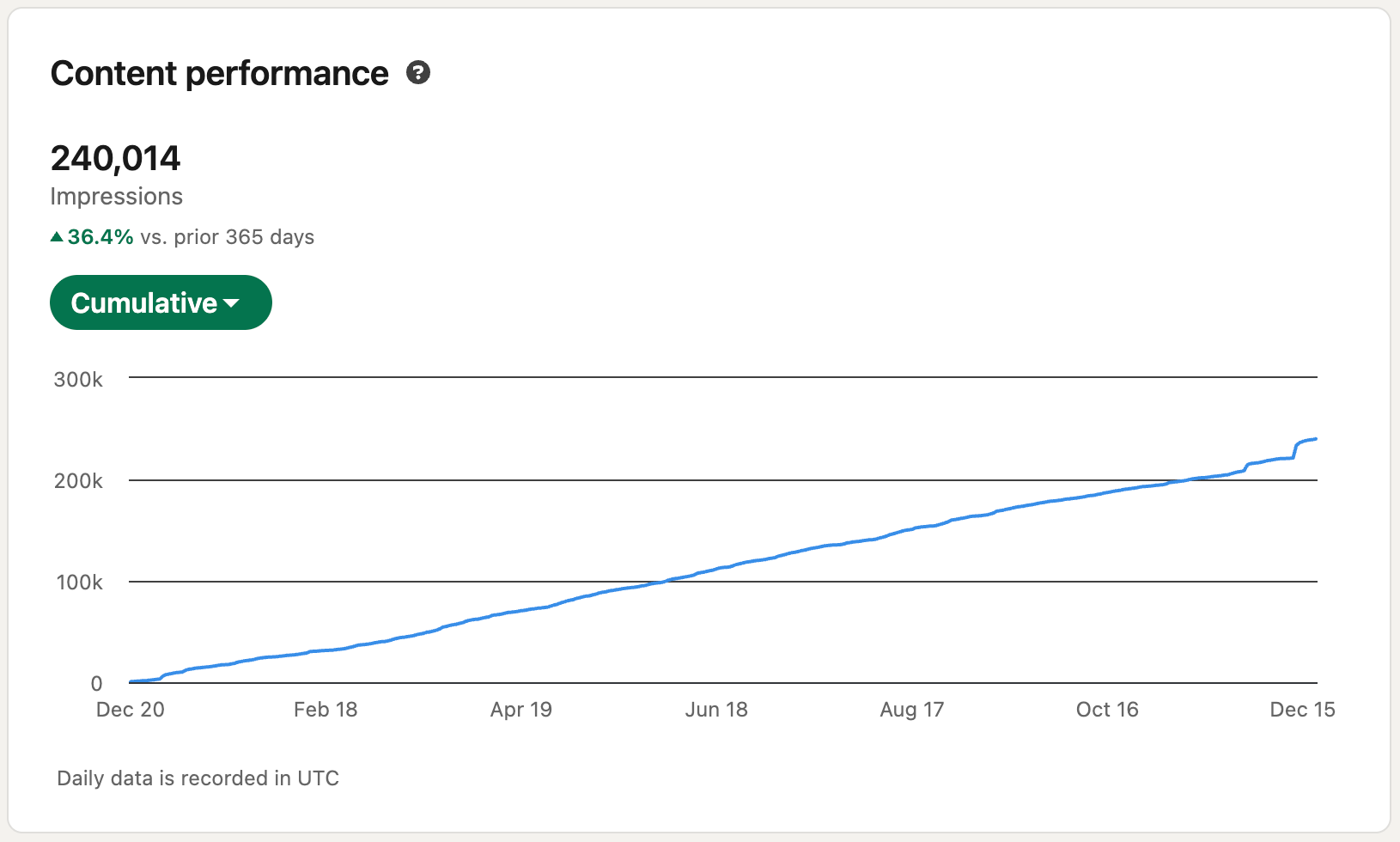
If you want a no-fluff shortcut to what actually drives reach + comments on LinkedIn (and what to double down on in 2026), this is my data-backed recap of 240,014 reached—plus the patterns that made the difference.
I’m also sharing the exact workflow (video walkthrough at the bottom) and my custom GPT link so you can generate your own year-in-review without living in spreadsheets.
Read time: 8 minutes
This newsletter was drafted with the help of ChatGPT, then refined and human-edited by yours truly before publishing.
📌 Present: Why I Built This
LinkedIn dropped its first-ever “Year in Review” feature last week. Cute. It told me the one person I connected with most… which is nice to know, but not exactly the kind of info I can use to get better at content.
So I built a custom GPT to generate my own 2025 LinkedIn Year in Review using my actual LinkedIn exports.
Result: over the past 365 days, my content reached 240,014 people — that’s like packing out the Sydney Opera House 42 times… which is a lot of polite clapping. 👏
I also recorded a video walkthrough showing exactly how I created this review (scroll to the bottom). And as a thank-you gift for being a subscriber, I’m sharing the link to my custom GPT so you can generate your own.
💡 Perspective: What The Data Says
Here’s what I think is true about LinkedIn (and it’s mildly annoying):
The posts that do well aren’t always the ones you plan like a launch campaign. They’re usually the ones that feel specific, human, and easy to react to.
A few highlights from the year:
Biggest reach post: “Redundant, Not Broken.” — 15,360 impressions
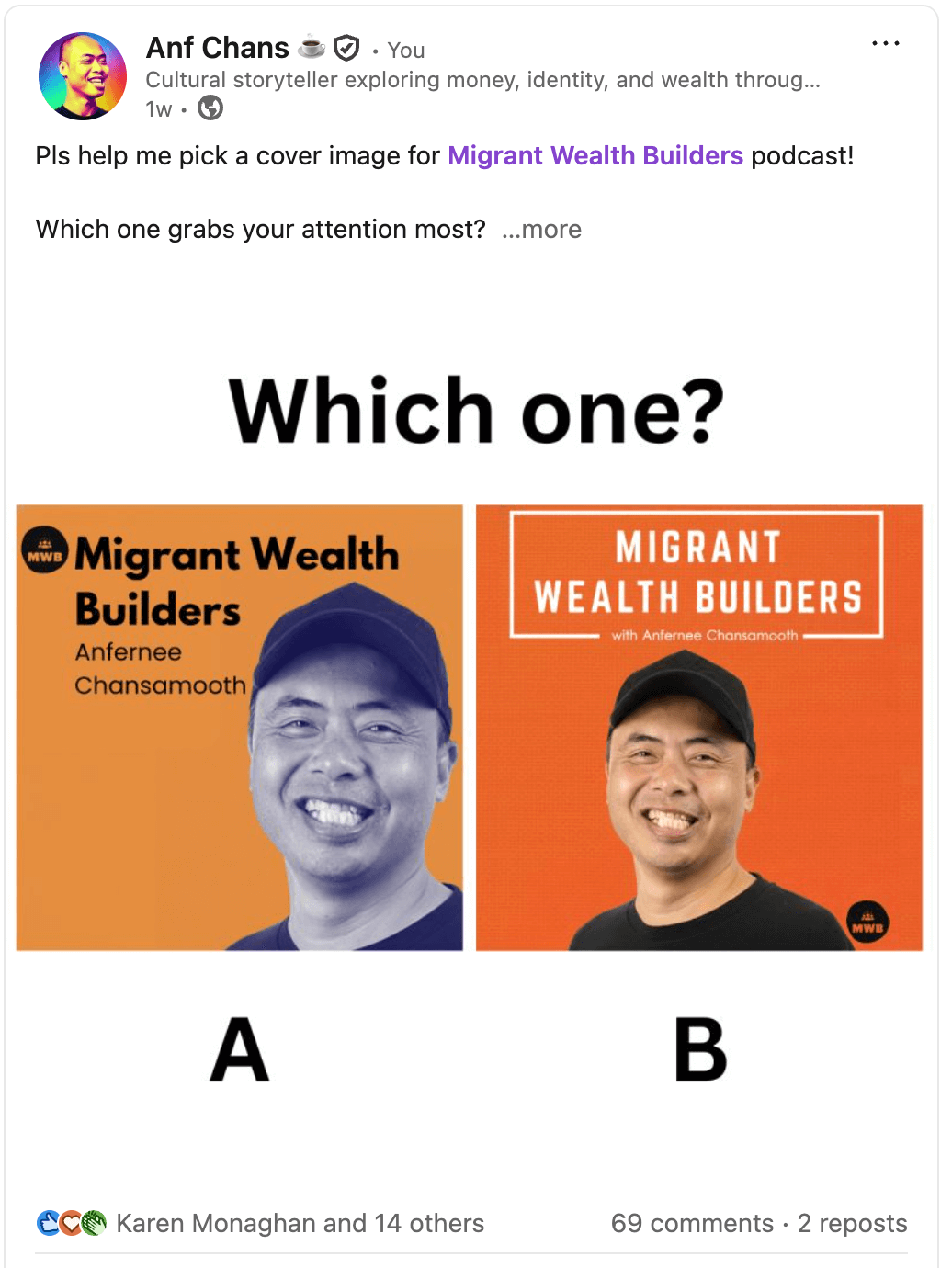
Most comment-heavy moment: “Pls help me pick a cover image…” — 69 comments
Career updates still do numbers: “I’m happy to share that I’m starting a new position” — 64 comments
Also worth bookmarking: LinkedIn’s Gyanda Sachdeva (VP Product Management) wrote a very practical article, “Answers to Top LinkedIn Feed Questions of 2025,” which is basically the clearest “how the feed works” explainer I’ve seen.
🚀 Progress: Patterns That Worked
Once I separated “reach posts” from “reply posts,” the patterns got obvious.
What got reach:
The best performers opened with a tension people recognised instantly:
These posts are basically: “Here’s a real problem. Are you also living this?”
What got replies:
The most engaged posts gave people a job.
Not “watch me perform.” More like:
help me decide
tell me your version
add your take
My cover-image post didn’t get 69 comments because it was genius.
It got 69 comments because it was participatory.
Top 3 themes that carried my year:
Career resilience (with receipts) — messy middle stories, but structured
Modern work friction — specific, relatable “I’m fine but…?” moments
AI curiosity — grounded experiments, not hot takes for sport
What worked (patterns, but make it spicy):
Vulnerability with structure beats “thought leadership with vibes.”
Questions outperform statements (because LinkedIn loves homework).
You have two lanes — brain + heart — and when you blend them, it hits.
Here’s the bonus insight: the GPT only knows what the data tells it. It can’t see what I saw.
So I added one key observation manually — because context matters:
Many of my best-performing and most-engaged posts were event recaps that included photos and tagged people.

And to get that into the recap, this is the exact follow-up prompt I used:
“add an observation, many of my best performing and most engaged posts were recaps of events I’d attended, where I included photos and tagged people. (note, why this is the case)”
Why it’s probably true:
Photos compress context (scroll-stopper + instant vibe)
Tags widen distribution (your post travels through networks, not just followers)
Shared experiences spark comments (attendees add nuance; non-attendees ask questions; lurkers feel safe to chime in)
Honestly, event recap posts are also the most fun for me because I get to go out into the real world, meet cool people, and learn stuff. Writing the recap reinforces what I've learned and gives me the warm fuzzies from seeing photos of the awesome peeps I hung out with.
It’s one of the few formats where “value” and “vibes” can coexist without fighting.
They can also help other people feel like they were there.

🎁 Payoff: Why It’s Worth It
Here’s why it’s worth investing in LinkedIn in 2026 (even if you’re allergic to personal branding):
LinkedIn is one of the few places where a single well-timed, well-structured post can still create real compounding returns:
new relationships that didn’t exist yesterday
opportunities that show up because people understand your work
credibility that builds quietly while you’re busy doing your job
a searchable “body of proof” that makes you easier to trust
And the best part? You don’t need to post daily, be loud, or be cringe.
You just need to show up with clarity, specificity, and a repeatable format that your network can react to.
That’s what this year-in-review gave me: a feedback loop.
Not “more content.” Better bets.
TAKEAWAY (for me): My Q1 2026 Plan
This recap gave me a clearer playbook for Q1 2026 — not “post more,” but post with intent:
At least 3 posts per week in Q1 (enough volume for patterns to show up)
At least 1 video post per week (text hook + captions + visuals; useful > cinematic)
Weekly Sunday #anfShoutouts (spotlighting valuable content in my network and showcasing #realhumans who spread positivity, share insights, and teach generously).
Bonus motivation: My video “AI vs The Artist” was selected for LinkedIn’s Top Videos of the Week this week. So I’m taking the hint and leaning harder into video next year.
If you want to build your own year-in-review, I made it easy:
Watch the walkthrough video below — it shows the exact workflow (and exports) so you can replicate this in under 10 minutes without guessing.
Grab the custom GPT link below — it’s a purpose-built assistant that turns your LinkedIn export files into a clean Year-in-Review summary + insights, so you don’t have to manually spreadsheet your way to clarity.
Feed it your LinkedIn exports and let it do the heavy lifting
Add your own human context where needed (because AI still can’t read your mind)
TAKEAWAY (for you): One Key Move
If you take one thing from this: make your posts easier to respond to.
In 2026, don’t aim for “viral.” Aim for participation:
ask a real question
share a useful recap (especially from events)
invite a choice, a story, or a perspective
Because people don’t just engage with content. They engage when you give them a seat at the table.
By the way, if one of your goals is to do more videos next year, then you might want to join me at Pat Flynn’s free 30-Day video challenge, which kicks off Jan 12.
Custom GPT Video walkthrough
Here’s a quick walkthrough showing exactly how I exported my LinkedIn data, fed it into the custom GPT, and turned it into a Year-in-Review in minutes (so you can copy the workflow without guessing).
A thank-you gift: my LinkedIn Year in Review Custom GPT link
To thank you for being a subscriber and following my journey this year, you can use this Custom GPT to generate your own LinkedIn Year in Review in minutes.
If you use it and publish your recap on LinkedIn, I’d genuinely appreciate it if you tagged me and mentioned you used my custom GPT — it helps other people find it.
Copy/paste sentence:
“I generated this LinkedIn Year in Review using @Anf’s custom GPT — if you want to try it too, check out their Substack.”
Thank you for reading (and supporting) my writing this year — it genuinely means a lot, and I don’t take your attention lightly. Wishing you a wonderful end-of-year break (whatever you’re celebrating or not).
If you’re in reflection mode, here are 15 Questions For Your Best Year Ever.
Know someone who would benefit from this newsletter? Send it their way!
Live Confidently & Passionately,
PS. Ready to level up? Here are four ways I can help:
Follow me on LinkedIn for tips and insights during the week (free).
Hire me to write content for your business or teach a marketing workshop/course. Let’s Talk.
Ask me about my done-with-you coaching program for startups.
Book me to speak on your podcast, summit, or in-person event.